Showing posts with label humanitarian. Show all posts

Wednesday, July 28, 2021

Community Based Seismic Retrofitting Program for Disaster Risk Reduction

Seismic retrofitting improves community resilience on housing. Even it is smaller activities compare to the post-disaster reconstruction. It is still workable even during Covid-19 pandemic on reducing earthquake risk on densely populated houses. This writing is based on retrofitting program implemented by Indonesian Red Cross and supported by the American Red Cross and Build Change, and funded by USAID. The program takes place in Indonesia at a city and at a sub-district which are located at earthquake prone area.

Many houses were poorly built in the earthquake prone area; therefore, they are in vulnerable state. Homeowners might not realize that they are at risk until earthquake with certain magnitude occurs. Their houses might collapse or might have significant damage. Therefore, these houses need to be seismically strengthened as a disaster risk reduction measure. In densely populated community this initiative become more crucial since large-scale houses might collapse if earthquake occur. Moreover, the debris might block their narrow evacuation route. Even retrofitting is less expensive compared to the rebuilding cost, but due to unavailability of funding more people reluctant to retrofit their houses.  During the program implementation, several initiatives have been taken to promote seismic retrofitting and strengthened with the community engagement initiatives. All of these are to create retrofitting demand at community level.

Seismic retrofitting and disaster risk reduction

Photo: Retrofitting with conventional method

Seismic retrofitting is to modify the existing structures to make them more resistant to the seismic activity due to the earthquakes. After the retrofitting, the structure could be damaged by the earthquake at certain elements such as beams but must not catastrophically collapse. Retrofitted house might prevent sudden failure which might cause its dwellers get injured. Seismic retrofitting can be done either in recovery or in preparedness setting. But to carry it out under homeowners’ initiative on preparedness setting is bit difficult compare on post-disaster recovery. During recovery process the house owners have the urgency to repair and retrofit their houses. On the other hand, without disaster occurrence homeowners tend to put retrofitting below other priorities.

There are similarities whether it is in recovery context and preparedness setting. Retrofitting is intended not to demolish the house but to strengthen it. It is the cost, to begin with. Cost-benefit assessment is used to evaluate the effectiveness of various seismic retrofit strategies to address concerns about earthquake safety and damage to older concrete frame buildings. When houses evaluated on the basis of repair costs only, the maximum cost of retrofit measures that offer a positive rate of return is 10% to 30% of the building replacement value.[i] Secondly, retrofit need skilled masons and under experienced technical person supervision. It is because seismic retrofitting need’s structure evaluation to check its vulnerability, design and then the construction work itself.

Since the cost is less than to construct from foundation to the roof, retrofitting can be implemented in every economic situation. During economic slowdown, retrofitting provides important contribution to the local economy. The construction work will provide job for builders and workers from other related sectors. Even it is a small-scale activity compared to the common construction work, the construction process needs inputs from other industries and production factors. This could generate considerable employment through multiplier effects.[ii] But its impact on the economy still depends on the volume of the retrofitting work within the area. The bigger the demand it will bring more resources and increase in economic activities. Moreover, the retrofitting cost might even less than 30%, if the activities reach economies of scale.

Naturally construction works always need time to reach the pace and amount of work of economies of scale. Surely kickstart always not easy and simple. It needs preparation such as training for builders, construction material provision, structure assessment and lastly homeowner confidence on retrofitting. Therefore, to ensure the retrofitting program can be implemented those for aspects should be prepared. In this writing, as it will be focused on the community engagement.

Challenges on proper construction and retrofitting

In every country the Government issued Building Codes that the people need to follow to ensure that they can have robust and earthquake resistant structure. The code also available for structural elements such as beam, column and foundation. The code also expected to be a guidance for design and prerequisite to get building permit. But the challenge is on the compliance. In the developing world, the compliance mostly only happens at multi story buildings not at one or two story landed houses. The situation even more challenging in the rural since the monitoring for compliance and enforcement is quite rare. In most countries, house builders or masons do not think that they are responsible for the vulnerability or collapse of the houses they constructed[iii].

Brick gable wall without concrete frame

Photo: Brick gabble wall without concrete frame

In rural area construction practices are far different from the code. The builders are confident about the safety of the houses which they constructed although most of builders do not know the building codes[iv]. For instance, in a village in in Sukabumi, West Java, Indonesia the houses have no columns. The builders laid the brick at the stretcher face not at their bed. Besides of the ignorance of the codes, people done this because they want to save money by putting less brick. Another example is how the homeowners and builders construct brick gable wall. Since concrete structure is being considered costly, the builders constructed it without concrete frame which make their houses are quite vulnerable when the earthquake occur. The risks are when the earthquake occurs, the brick gable wall might fall off. Surely it can endanger the house owner since it is catastrophic.

Ignorance of the Building Codes is the first barrier to have safe structure. The next barrier is the economic cost of retrofitting. Currently, retrofitting is at the supply driven rather than demand driven as homeowners are heavily dependent on grant or financial incentives. homeowners are unwilling to invest in their house as the house is not a source of income for them and seismic safety is not a priority for them.[v]

If the people are willing put themselves at risks by putting no column at the wall it will be difficult to persuade them to retrofit their house. Some people put the retrofitting at lower priorities then other needs, even though they received the information on earthquake risks. Earthquake is not always occurred regularly like flooding which has seasonal occurrence. People easily forgotten. Even if people have sufficient money, they want to enlarge the houses or just put new paint in their houses.

Another challenge on retrofitting is unavailability skilled builders and proper construction material which need to be used in retrofitting. This can be easily understood since retrofitting is not common in the area therefore it is difficult to find builders which have retrofitting skills. Also, if most of the houses in the area were built without following the Building Code, then it is difficult to find construction material as directed in the code, for instance on using steel deformed rebar. Steel deformed rebar is prerequisite for earthquake resistance reinforced concrete structure. In those area, the demand for deformed rebar is less than the smooth rebar, hence the deformed rebar become expensive.

Creating the demand for retrofitting

Provision of skilled builders and retrofitting material is directly proportional to the demand for retrofitting. The more people want to retrofit their houses the more builders come and work in the area. New builders will be introduced to the retrofitting technique by the skilled builders, as they will work as an intern. More construction material will be available due to the needs of ongoing retrofitting work. Then how to increase the retrofitting demand?

Photo: Retrofitted house using Ferrocement technique which developed by Dr. Teddy Boen

The recent development, many retrofit strategies are feasible and several traditional and innovative options are available to engineers[vi]. There are research and studies on retrofitting which can be implemented on using available material and with affordable price. For instance, ferrocement[vii] technique which developed by Dr. Teddy Boen, can be implemented with simple technique and at an affordable cost. And depends on the needs, homeowners also have the option on choosing conventional method by adding seismic resistance attribute to particular structural element.

Other than the engineering approaches is the encouragement with social language using the positive messages, i.e. homeowners are crucial to be convinced that the investment in safer housing will eventually prove to be worthwhile.[viii] On the other hand from the negative messages, it is also important to increase disaster imagination of the people to understand the importance of seismic retrofit of weaker houses that is the main cause of casualty and to create some social systems by which homeowners are encouraged to retrofit their own weaker houses by themselves.[ix] These initiatives should carried out by trained community volunteers.[x]

Other initiatives to create demand is through connecting the people with the banking institution. Some of banks have financial loan for house renovation but they do not have loan for retrofitting. The bank has been approached and currently is calculating the potential market and benefit of the loan program.

Currently Indonesian Red Cross is developing strategic level collaboration with the Public Works and Housing, to re-shape the government program. It is expected that the current house renovation program which funded by government can be changed to house retrofitting. More retrofitted houses also mean more training opportunity for the builders.


Photo: Training of community volunteers to equipped them on their role as Retrofitting Agents. 

Another campaign done by the trained community volunteers who are using the retrofitted houses as retrofitting showcase. People invited to visit the houses, discuss with the homeowners and trained community volunteers. This campaign was launched to create bandwagon effect in the community. The Community Volunteers acted as Retrofitting Agent visited homeowners door-to-door sending the messages of retrofitting. 

Still, more effort needs to be made. Supply chain is one important area need to be developed. The need of affordable construction and retrofitting material such as deformed bar, wire mesh, Polypropylene (PP) bands or fiber-reinforced paint should be available in local shop. At the end it will reduce the cost.

Collaboration with other humanitarian organization program, such as livelihood and others, need to be developed. Improved quality of living of the society will increase homeowners’ capacities and then at the end they may retrofit their houses.

All of these should be seen as approaches which can strengthen the community effort, since the retrofitting awareness should be a bottom-up initiatives. Homeowners who eventually aware on earthquake risk reduction should be able to connect with available retrofitting resources. Then at the end the retrofitting can be implemented and initiated by the community.

 Arwin Soelaksono


[i] Liel, Abbie & Deierlein, Gregory. (2013). Cost-Benefit Evaluation of Seismic Risk Mitigation Alternatives for Older Concrete Frame Buildings. Earthquake Spectra. 29. 1391-1411. 10.1193/030911EQS040M.

[ii] Wibowo, M. Agung. The Contribution of The Construction Industry to the Economy of Indonesia: A Systemic Approach (2009)

[iii] Okazaki, K and T. Saito.   Seismic Risk Perception Concerning Non-engineered Houses (2012)

[iv] ibid.

[v] Build Change, 2019.

[vi] Zerbin, Matteo . et. al. Sustainable retrofit design of RC frames evaluated for different seismic demand (2015)

[vii] Boen, Teddy. Retrofit Bangunan Yang Rusak Akibat Gempa , 2015, 2019 https://www.teddyboen.com/Retrofit_Bangunan_yang_Rusak_akibat_Gempa.html

[viii] Okazaki, Kenji et. al. Study on willingness of the residents in seismic retrofitting of the house - comparison among Indonesia, Nepal, Pakistan, Turkey, The Philippines, Fiji, and Japan

[ix] Sathiparan, Navaratnarajah. Mesh type seismic retrofitting for masonry structures: critical issues and possible strategies. European Journal of Environmental and Civil Engineering. Volume 19, 2015

[x] In Indonesian Red Cross (PMI) program, supported by the American Red Cross and Build Change and funded by the USAID, the trained community volunteers (known as Community Based Action Team) acted as Retrofitting Agents. They have been trained how to spot vulnerabilities, provide retrofitting option and solution including calculating retrofitting budget. On their role the Retrofitting Agents are equipped by Retrofitting field guide the help them during house visits and encourage their neighbors to retrofit their houses.

Tuesday, June 30, 2020

Shelter recovery assistance amid the Covid-19 pandemic

Following a disaster which causes house damage, homeowners always want to repair or rebuild their houses according to their own recovery pathways. In some recovery, non-governmental organizations supporting homeowners with various assistance in order they can rebuild safer houses more sustainably. Unfortunately, amid the pandemic, size of assistance are decrease due to limit of staffs movement in the field. Consequently Build Back Safer (BBS) would be difficult to achieve due to lack of technical assistance. On the other hand, there are organizations who had invested on developing capacity of builders and homeowners also adding health and safety measures. They might expect to achieve both, the community might build back safer and improve protection from Covid-19.

Shelter self-recovery and pandemic

In many events, number of houses damage, along with number of casualties are indicating the magnitude of the disaster. Affected people whose houses were damaged tried as soon as possible made makeshift tents or built or find temporary shelter. Shelter is universally recognized as a foundational element of disaster recovery; and while its ability to provide protection from the elements is a core function, it also affords broader social and economic benefits.[i] Many of them are living in temporary shelters. Some of them live with families outside the affected area or dwell in rental houses. Every households have their own pathways to recover.

Learned from the hard way from Aceh, Indonesia, post-tsunami recovery which was heavily donor driven. It was housing recovery led by agencies with little participation from the homeowners. The participation even became lesser due to competition amongst NGOs[ii]. But during last decade the approach has changed. Government and NGOs are more aware on self-recovery. It is an inevitable process. Following a disaster, populations never remain passive[iii]. Most disaster-affected families rebuild their homes relying on their own and local resources, with little or no external assistance[iv]. Even it will take months or years. Hence the role of government and NGOs on providing assistance is to complement the needs of self-recovery. The assistance should be supportive, focusing primarily on enabling and assisting household self-recovery and strengthening systems towards more sustainable outcomes and processes[v].

Nowadays there are various program are currently implemented to support the recovery. For instance, supporting the homeowners with cash-based program. Depending on the program, the cash can be delivered in stages or just in one time. Even the amount only 20% - 40% from the needs, but the cash can be used as a stimulus to kick-start the repair or rebuild houses. Other NGOs currently support on BBS initiatives through builder and homeowner training. Other helping the builders through mentoring to ensure all builders are familiar and can apply the safe structure attributes. Therefore, the presence of engineers, trainers and skilled builders are essential to empower homeowners and their builders.

Unfortunately, due to the Covid-19 pandemic, many agencies have to limit their staffs’ presence in the field. Even they might aware that without sufficient support, local builders and homeowners might turn to old practices which result to unsafe structure. Also, there are still people in tents or other cramped spaces which make the risks become higher. It is a dilemma for the organizations. They need to protect their staffs’ but it might leave the homeowners become more vulnerable to the pandemic.

Adaptation through setting example and system

No one was aware of this pandemic when designing the recovery program. It came at a sudden which made every organization has to modify their program. To those who are flexible and have sufficient resources, they can continue and at the same time practice safety measures. They have to work together with the community to break the chain of transmission. As long they can practice physical distancing, always wear mask and the builders and homeowners can wash their hands. Then some organization add hand washing facilities to their shelter and housing recovery program. Hence it is a holistic integrated approach to housing. It is good to have some provision for integrating aspects such as infrastructure, water and sanitation into housing projects as these enhance the quality of settlements in the post-disaster context[vi]

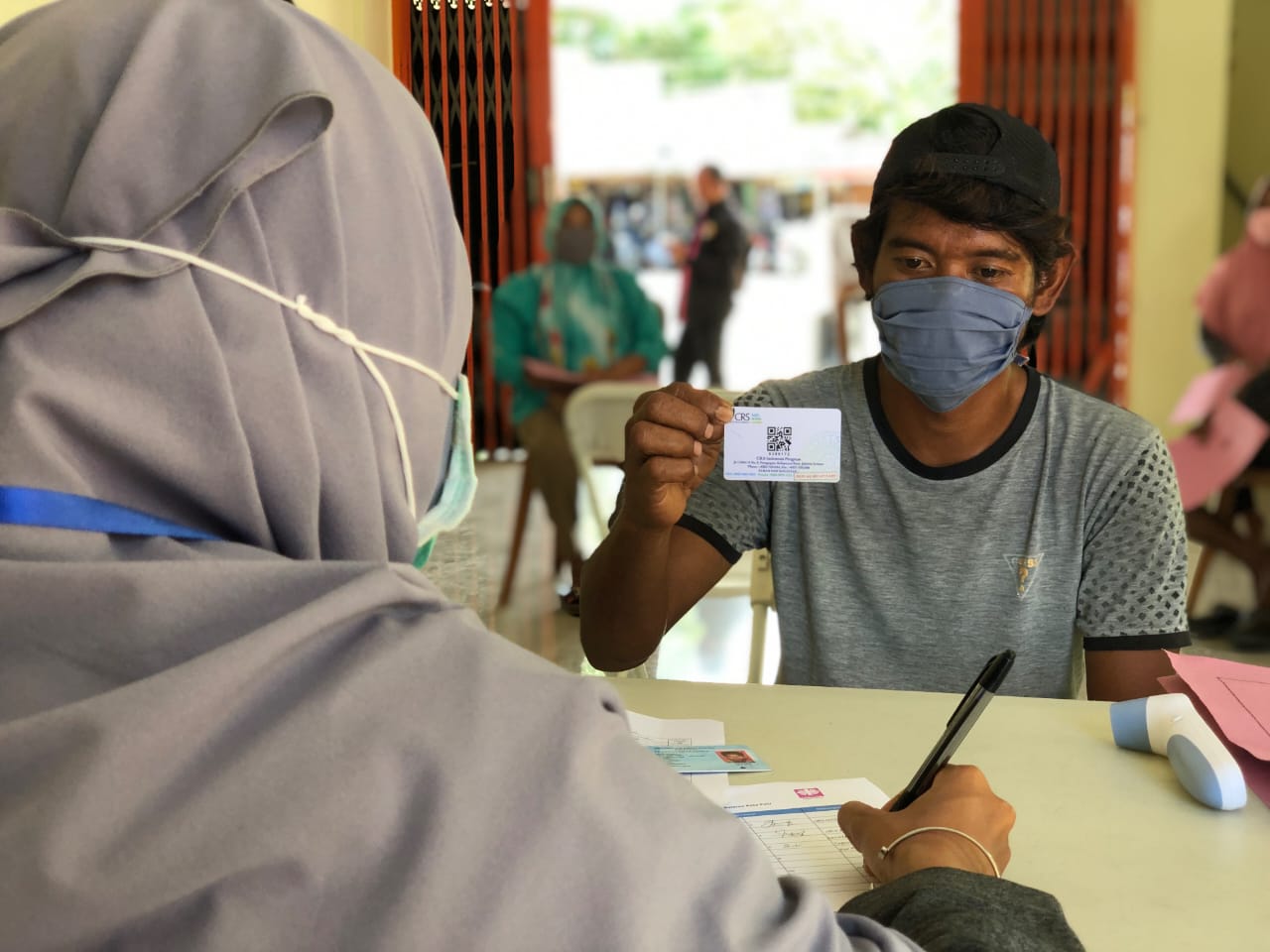
Aside on technical assistance, setting an example become essential. Some organizations are quite strict on imposing physical distancing. When receiving cash assistance, the beneficiaries have to maintain certain space. They require all beneficiaries to wear mask. All these safety measures are new; therefore homeowners and builders are not used to it. They need to be educated that wearing mask is to protect themselves and their society. Therefore, community leaders have to give example that they themselves willingly practice it. They have to wear masks and mandate others to wear masks. In their area should be widespread mask-wearing which might be a very effective complement to hand-washing, physical distancing and other measures to mitigate the pandemic[vii]. Community leaders have to utilize social capital which is function of social norms, participation, and network[viii] in order every member in the community would internalize these safety measures. Therefore, wearing mask is people solidarity to protect their neighbour.

Creating system which would strengthen safety measures should be in place, even it should be provided earlier. Some organization provide thermometer gun to check those with high fever are not be allowed to work or gathered in public meeting. Provision of masks and handwashing station beforehand would encourage builders and homeowners to adapt the new practices. Also setting safe space to ensure sufficient distance during cash distribution or other assistance.

From project management side, homeowner can be advised to limit the number of their builders otherwise physical distancing cannot be met. Limiting the presence of builders is much better rather stopping the construction. The shelter program needs to continue because it is related to the builders’ livelihood. But unfortunately, those measures mentioned above are too luxurious to settlement with dense population and difficult to have sufficient clean water.

Future of shelter recovery assistance

This covid-19 pandemic gives us time for us to pause and reflect, on what will shelter recovery assistance in the future. No one knows when this pandemic will be over. But we know there would still a need to support shelter recovery. Since both pandemic and shelter post-disaster recovery are across the globe, there should be reshaping on type of assistance. Safety and health measures should be taken into account which should be reflected on the planning and budgeting. Therefore, shelter assistance should be redesigned. It should consist the most essential part which can meet the need of owner-driven recovery strategically. At least there should be three measures in place on recovery assistance can be described below.

Support owner driven recovery using technical assistances. Government and non-government organization should invest on developing homeowners and builders capacity. Training on BBS should be provided.  They may do so by bringing specialist builders in, by imposing standards, or providing assistance[ix]. Provide mentoring for local builders also smart investment in order they can adopt safer construction standards. Messaging on BBS also important. Every post-disaster recovery is unique. Hence all organization should find how to help the builders and homeowners on understanding the principles of BBS[x]. They should have the confidence that they can rebuild their houses properly. All of these are intended to build internal capacity within the community. At some point the external support could be disrupted or ended, but they still have the ability to continue their recovery process.

Connect shelter recovery with livelihood. Shelter and housing recovery post-disaster in many occasions viewed as overly time consuming and costly. The bigger the gap between available resources to the needs, it could be more sensitive to inflation and speculation. Bricks, cement, timber, steel rebar, masons and carpenters scarcity happened many times along with the size of the recovery. Therefore, shelter and housing construction work should be complemented with creation of market and strengthening supply chain. In this view, lockdown to an area to protect the community from Covid-19 would not be the best solution. Builders and supplies from outside cannot reach the affected community and at the end would affect local livelihood. As written above reducing the number of builders to maintain physical distancing is still an option. Even it would slow down the construction pace, the builders still can work and earn their income. The market still survives.

Link construction work with hygiene promotion. In many shelter recoveries there are initiatives to give the homeowners access on clean water and sanitation. Some organizations provide toilets as part of the shelter program. But seeing from this pandemic there should be upgrade on the assistance. Hygiene promotion become essential part of the shelter recovery. Provision of handwashing facilities and education on proper handwashing should be part of the service to the community. It does not mean that the shelter organizations have to provide all assistance in one package. Partnering with organization who are expert on hygiene promotion will be one of the solution.

Arwin Soelaksono

Photos:

Top:  Courtesy of Arsitek Komunitas (Arkom) Indonesia

Middle: Courtesy of Catholic Relief Services

Bottom: Courtesy of Wahana Visi Indonesia


[i] Opdyke, Aaron. Resilient and Sustainable Infrastructure Systems: A Comparative Analysis of Post-Disaster Shelter Coordination, Stakeholder Participation, and Training. ProQuest LLC. 2017.

[ii] Soelaksono, Arwin. NGO and Donor Coordination to Speeds up Reconstruction and Avoid NGO Competition. 4th Anual International Workshop & Expo on Sumatra Tsunami and Recovery in Banda Aceh. Proceedings. 2009. https://www.scribd.com/document/60616872/NGO-and-Donor-Coordination-To-Speeds-up-Reconstruction-and-Avoid-NGO-Competition

[iii] Schofield, Holly., Barriers to urban shelter self-recovery in Philippines and Nepal: lessons for humanitarian policy and practice

[iv] Twigg, John., et. al. Self-recovery from disasters. An interdisciplinary perspective. Working paper 523. Overseas Development Institute 2017

[v] Humanitarian Shelter and Settlements Guidelines. DG ECHO Thematic Policy Document n° 9. 2017

[vi] Hidellage, Vishaka., and Usoof, Aziza. Scaling-up people-centred reconstruction: Lessons from Sri Lanka’s post-tsunami owner-driven programme. Building Back Better Delivering people-centred housing reconstruction at scale. Practical Action Publishing Ltd. 2010

[vii] Manjoo, Farhad. It’s Time to Make Your Own Face Mask. https://www.nytimes.com/2020/03/31/opinion/coronavirus-n95-mask.html

[viii] Nakagawa, Yuko., and Shaw, Rajib. Social Capital:A Missing Link to Disaster Recovery. International Journal of Mass Emergencies and Disasters. 2004

[ix] Schilderman, Theo. Putting people at the centre of reconstruction. Building Back Better Delivering people-centred housing reconstruction at scale. Practical Action Publishing Ltd. 2010

[x] Shelter Cluster with some organizations develop key messages on Build Back Safer. The key messages are principles which is very concise and expected to be easy to memorize by the builders and homeowners. For instance following the earthquake in Central Sulawesi in Indonesia the key messages can be downloaded at https://drive.google.com/file/d/1aYNaRQcWBZlyg3GBa1g02N4F6To623gY/view . Another key messages was from Gorkha Nepal earthquake which BBS key messages can be downloaded at https://www.sheltercluster.org/sites/default/files/docs/english_151124_10_key_messages_0.pdf


Sunday, March 17, 2019

Supporting the most vulnerable in owner-driven house reconstruction setting – Lessons learned from Nepal


On every houses reconstruction post-disaster there is always challenging situation where there are some people will potentially left behind. The most difficult to assist are those who are the landless or those whom will be relocated. Their timeline and reconstruction cost will be much higher compare to those who are on-site reconstruction. Based on this circumstances both landless and relocated will not be discussed in this article. Therefore the scope of discussion are those who will rebuild their houses in their previous land or upon their own land. Even though there are families with economic vulnerability, whom struggling to fulfill their daily needs. There are also families without workforce, the old people and people with disabilities which made them have no confidence to rebuild their houses. When the government launch the recovery program across the affected area these people most probably will only wait for the right time to start but soon will they realize it is already late. These people are based on common criteria[i] known as the most vulnerable.

But there is always possibility on supporting the most vulnerable families to rebuild their houses. Even most of them don’t have confidence that they might even start the construction. There are many question on their capability to rebuild their houses in owner-driven setting. To answer the question, firstly we need to understand how they perceive their limitation and perception on reconstruction.

Different timeline

The most vulnerable families have different timeline on rebuilding their houses. They might think for months to have decision to ground-breaking. They might worry once they start and then they could not finish it. For instance, in Nepal one room house can be completed within 2 months or even less. But for most vulnerable families might take a year to complete. Nepal government provide cash assistance for all eligible beneficiaries to rebuild their houses in 4 tranches. For those who can afford to buy construction material or pay the labor they can use their own resource to keep the construction going. But not with the most vulnerable, which they can only work when they have the cash assistance on their hand. It happened many times there were time lag which made them to wait[ii].

Therefore since we know that the most vulnerable need more time to rebuild their houses, the support should be start earlier. Whatever the support to them such as the top up or other assistance should be started sooner. The recovery assessment should identify the most vulnerable and work at the earliest to get buy-in from their own community and local government.

Start the ball rolling

My first question when we conducted the assessment 3 months after the earthquake who will do the land clearing when we visited old people. They seems did not have man power for land clearing. The access also difficult to bring the material to their houses. If the job should be done by labor, they don’t have money to pay the wages. They stuck in this condition and need external support from government or humanitarian organization. This external support needed to start the ball rolling.

There are various ways on supporting the most vulnerable that they might kick-start the rebuilding. There was cash top up as per government plan to support the most vulnerable. Some organization using the local custom to gather several homeowners to form a group to build their houses. They started from one house then to another house as they agreed. It went well since it is traditional practice, but it takes time. They need to finish one house at certain stage then to move to other houses. It take even longer time due to seasonal work in the village[iii]. Some organizations provide construction assistance through training for builders. The training was started from land clearing until the house completed. The homeowners just provide the material. The builders get the benefit of experience to work on complete construction; on the other hand, the beneficiaries’ also get the benefit since they have their houses constructed in good quality. It went well but the number of beneficiaries not so many.

After several studies and discussion with several organizations in the HRRP[iv], the most effective support was provision of mobile mason. Mobile mason is providing a group of mason who works up to certain level of construction. The masons will clear the land and dig foundation. They will work to construction of the foundation until the foundation beams are concreted. Up to this level the beneficiaries are entitled to get the cash disbursement which is the largest tranches of government scheme. Once the ball rolling they will continue to finish their houses. This intervention was the most efficient since it took only a week[v]. Also it is cost effective since the beneficiaries can provide their salvage material to be used for construction of foundation. They only need to purchase steel rebar and cement for the foundation beam. For the organization who support the most vulnerable this is also cost efficient since they have to pay labor for a week to finish the work. But the organization have to provide construction expert to provide technical assistance to the homeowners and the builders.

Therefore the most vulnerable people will have their capacity. The government and the humanitarian organizations need to break their limitation by providing accurate support. We need to respect their time line and at the same time help them to build their confidence and to kick-start  their house construction.

Arwin Soelaksono


[i] Every organization have their own criteria which based on their organization mission. The criteria might be old people, people with disabilities, single headed women, family with children, food security etc.
[ii] There is a process that they can receive the cash after at certain stages their construction work can be verified based on quality checklist. After the verification there will be several steps in local government process to ensure eligibility and correct amount to be disbursed. These process always take time and in some area it might take longer due to local capacity.
[iii] There were planting and harvesting and also festivals. There were also monsoons which hamper the transportation due to landslides.
[iv] The Housing Recovery and Reconstruction Platform (HRRP) is the organization who provides coordination services for the National Reconstruction Authority (NRA), Ministry of Urban Development (MoUD) and Ministry of Federal Affairs and Local Development (MoFALD) Central Level Programme Implementation Units (CL-PIUs), other relevant government authorities, and Partner Organizations (POs).
[v] The American Red Cross in March 2017, supported 7 families by providing mobile mason in Thulogaun. The support was from land clearing to the completion of the foundation. Therefore the beneficiaries can proceed to obtain the second tranche cash grant which is the largest chunk of government support. It took around 7 months up to  a year for them to complete their houses.